
What follows is my own personal ‘metabolisation’ of the teachings of Raja Yoga as purveyed by the Brahma Kumaris in the late 1970s. I don’t know if they have modified or moderated it since. For me it has a) always made perfect sense, and indeed b) has been and still is the basis of profound personal experience in meditation – which, I am told by those much cleverer than me, is anyway unreliable.[i] These are ideas to try out on yourself; if they make sense, as they did for me, having been brought up in Christianity (someone else take away my sins? How does that work?), then follow through.
The soul – and God is a soul – is / are not general overall consciousness. They / it are units of consciousness, con-science, that is, knowingness. Unique, indestructible, infinite in time but not in space. They are repositories of consciousness. Consciousness exists in them.1
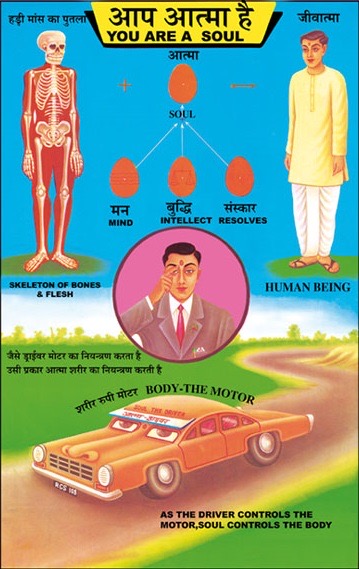
Don’t laugh. This is the style of the original teaching of the difference between Soul and Body to which I was exposed. The Brahma Kumaris have moved on from this naïve presentation, obviously; but the kernel of the idea is there, and was enough to lead me to profound experience.
The key to this particular understanding is the difference between physical and non-physical – Metaphysical, if you like – which is where many of us get stuck. Attempts are made to equate the divine with all things: God is omnipresent, God is in everything. Does that mean He/She/It is everything? Or just in everything? And if so, how did He/She/It get there, and does He/She/It also depart? Or are we talking about a sort of general miasma, some kind of ‘breath’ that inhabits all physical things and phenomena?
When we get to neuroscience it becomes even more tricky, and I, ever since I discovered and committed to the basic Raj Yoga idea of non-physical soul as vs physical matter, always step back when explanations of behaviour are based on biochemistry. I don’t have the science to refute the science; I just have belief, firmly supported by profound experience. I don’t anyway want to refute the science; demonstrably, people in distress or extreme psychosis are experiencing biochemical disorder. But the point is that this is a physical manifestation of the soul’s disorder. You are not your brain. Yes, physical and non-physical interact on each other, obviously. Depressed? You’re listless, low on energy. Happy? You’re bouncy, energetic.
But the question stands: When you say ‘my soul’, who is talking? When you die, your body is exactly the same as when you were alive (putrefaction, disease, wound or injury notwithstanding); but where are You?
I saw this clearly when I visited my father just before he died. I was a ‘white-clad boy’ at the time, sporting my white kurta-pyjama combination, the daily garb of the Raj Yogi, so I concede I was seeing what I was being conditioned to see … which is not to undermine the reality of the experience. A few days away from death, his skin was almost transparent, his body much shrunken, at the end of its useful life. I could see with my own eyes the soul getting ready to fly, straining against the last fading strength of its physical vehicle, working to free itself. My father the person was about to leave my father’s body.
Body conscious, soul conscious. Raj Yoga as taught by the Brahma Kumaris says body consciousness is the biggest mistake you can make: confusing your non-physical self with the physical organism which you inhabit is the root of all pain and suffering. Which is why in that teaching pretty much any action driven by the sense of yourself as a physical being – ‘body consciousness’ – is what Christians would call sin. Entwined with the philosophy – knowledge? – of karma, BK-style Raj Yoga does not use the word sin, although the idea is just as powerful: more so, perhaps, because Christianity holds that by asking God’s forgiveness the sin is erased. The God you meet in RY doesn’t have anything to do with your or my actions, sinful or otherwise. Karma takes care of that. He / she / It sees, knows and understands every single synapse, every single thought, every single feeling, every single attitude, every single action – which for 8,187,935,259 people (accurate at 08:17 GMT 13 November 2024 but counting), is quite a lot of computing power. Lot of data, lot of processing, lot of storage. It’s all stored in His / Her / Its infinite consciousness. He / She / It knows your part in the drama, the role you play, the one you have played every time cycle since … well, time has no beginning and no end, so let’s just say for all time. That’s why looking into ‘His’ eyes, you are wholly aware that ‘He’ knows you wholly, entirely, sins and all – good, bad, ugly, beautiful, indifferent.
A lot to take in, sure, a Very Big Idea here. I can only say, in my own personal experience – and there are those who would challenge even that as a reliable account of objective reality – that I have looked into those eyes, they have looked into me, and I know this truth. It won’t be truth for everyone of course, but it’s good enough for me. It’s still my truth, even though I don’t live the daily life of the Raj Yogi – very much demonstrably so, which is the whole point of this blog / book / whatever it turns out to be. Scoff if you like but I’ve been there, looked, as I say, into those eyes; after 6 years of effort (2 of euphoria, 2 of struggle, 2 of plotting my escape) I couldn’t hack the requirements of the daily life and veered off into a life of ambivalence, sex, drugs, rock’n’roll, alcoholism, family, children, motorcycles, deep deep joy and deep deep pain. The idea here is to deliver a message of cautious optimism; you can love yourself and be as happy as you can be, despite the recurrent failures.
It’s worth saying at this point that this experience and my ‘membership’ or commitment to the institution that administered and enabled it – the Prajapita Brahma Kumaris Ishwariya Vishwa Vidyalaya, or Godly World University of the Virgin Daughters of Brahma – led me at the time – I was in my 20s – to discount and in a sense renounce or repudiate physical life. I had been studying hatha yoga with a serious intention to develop that lifelong practice, and I had already started teaching and taking teacher training, which is why I was privileged to be taught by BKS Iyengar himself (humiliation as a teaching tool, another story). As soon as I entered the Raj Yoga discipline, even at the very outside edges of novitiation (?), it was made clear to me that ‘physical yoga’ was not only a waste of time and energy, but plainly and profoundly the wrong path.
This sort of chimes with the traditional ‘8 Rungs on the Ladder of Yoga’ wisdom of Patanjali’s Yoga Sutras, which was often quoted at me but I have never read. A better translation is perhaps the Eight ‘Limbs’ of Yoga, each one of which is part of the practice of living a meaningful and purposeful life:
- 1. YAMA – Restraints, moral disciplines or moral vows
- 2. NIYAMA – Positive duties or observances
- 3. ASANA – Posture
- 4. PRANAYAMA – Breathing Techniques
- 5. PRATYAHARA – Sense withdrawal
- 6. DHARANA – Focused Concentration
- 7. DHYANA – Meditative Absorption
- 8. SAMADHI – Bliss or Enlightenment
And – perhaps I need to reconsider this, 50 years later – I was always given to understand that ‘hatha yoga’, or physical yoga as the Raj Yogis called it, was the bottom rung of the ladder and ‘Raj’ (or King) Yoga was at the top, a discipline you were only likely to achieve after many lives of sadhana or spiritual effort through the previous seven rungs.
A quick look at the Wikipedia entry on Rāja yoga gives you an immediate sense of the historic provenance of the term and its numerous practices and beliefs, the various devotional texts through the ages, the ‘four yogas’, the ‘five yogas’, Patanjali’s Yoga Sutras, the Yogatattva Upanishad, the Hatha Yoga Pradipika, the Dattātreyayogaśāstra … and a short dismissive sentence, which is where I come in: ‘The Brahma Kumaris, a new religious movement, teaches a form of meditation it calls “Raja yoga” that has nothing to do with either the precepts of Hatha Yoga or Patañjali’s Yoga Sūtras’.
So that told me.
Be that as it may, once you’ve accepted and engaged with a hermetic and entirely self-referential set of teachings and practices for daily life that go with it, that’s the only teachings you get. You want to develop, to go deeper, to study and practice, but once that’s your path, the others are not. Raj Yoga deals with other forms of spirituality through its ‘Tree of Religions’ idea (again, don’t laugh, this is from the 1970s, they’re much slicker now) – putting Christianity, Buddhism, Islam and other movements that have occupied the minds and souls of a few billion human beings over the centuries – placing them all as branches of the tree. The root – The ‘Seed’ – and tip of said Tree is God – the universal incontrovertible truth of Raj Yoga as taught by the BKs.
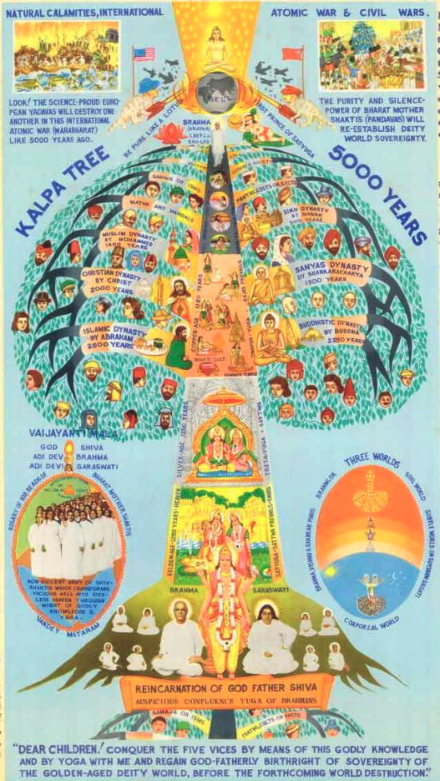
The point being, at that time I was taught to ignore the body, pretty much, if not actually neglect and discount it. This may be why so many of the senior members of the institution battle with chronic illness – but on the other hand, a good few of them have lived way past 100, which might just be the product of a ‘pure’ life and diet. Over the years I have returned to hatha yoga practice, and have no patience with a philosophy that ignores and even devalues the relationship between soul and body, or let’s say physical and non-physical being. The basic truths stay with me, as they have for many who were part of the institution in the 1970s; but life has taught me the beauty and necessity of balance.
[i] ‘Lots of research,’ says my friend and mentor (and tormentor!) and Very Clever Person Guy Claxton, cognitive scientist of great renown, ‘shows that “profound experiences” are (a) unreliable guides to any kind of objective reality (see e.g. psychedelics and phantom limbs) and (b) such experiences are treated – in zen for example – as makyo – spiritual trinkets and beguiling hallucinations – that divert you from the arduous business of shedding all comforting fictions and engaging fully with the here and now.’ No way was that experience a beguiling hallucination, says I. I don’t think ‘objective reality’ is what we’re dealing with here. I’m not trying to prove God exists.

