
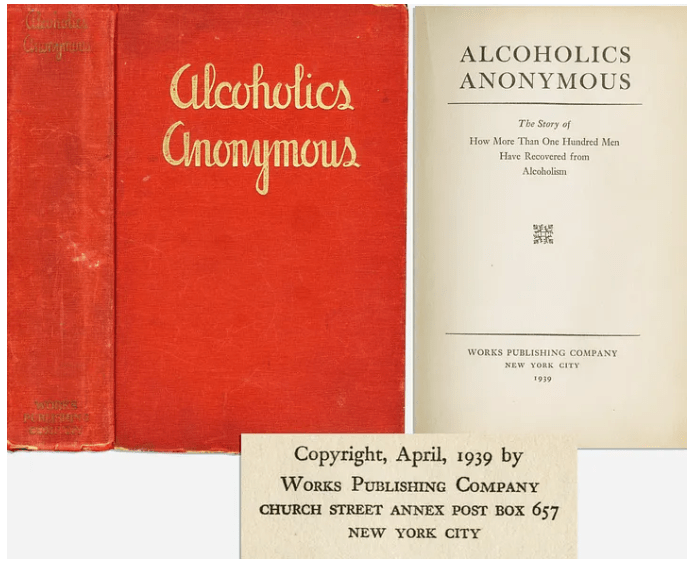
What is known as ‘The Big Book’ of AA, first published in 1939, originally entitled ‘Alcoholics Anonymous: The Story of How More Than One Hundred Men Have Recovered from Alcoholism’ is a basic text, describing how to seek recovery from alcoholism, says its Wikipedia entry. It was written by William G. “Bill W.” Wilson, the main founder of Alcoholics Anonymous, with the help of various editors and his collaborator Hank Parkhurst, who ‘influenced the more liberal notions of “God as we understand him” and “your own conception of God.”’ It is one of the best-selling books of all time, apparently, having sold 30 million copies. In 2011, Time magazine placed the book on its list of the 100 best and most influential books written in English since 1923, the year in which the magazine was first published. In 2012, the Library of Congress designated it as one of 88 “Books that Shaped America.”
AA’s famous ‘12 Steps’ method, with its ‘strong spiritual and social emphasis’, has become a standard technique for the treatment of all sorts of addictions including drugs, sex (?how?) and gambling.
Here are the 12 Steps as originally published – without the ‘as we understand him’ qualifier about God. Notice it’s all in the past tense (why?). There have been many ‘watered down’ versions:
- We admitted we were powerless over alcohol – that our lives had become unmanageable.
- Came to believe that a power greater than ourselves could restore us to sanity.
- Made a decision to turn our will and our lives over to the care of God.
- Made a searching and fearless moral inventory of ourselves.
- Admitted to God, to ourselves, and to another human being the exact nature of our wrongs.
- Were entirely ready to have God remove all these defects of character.
- Humbly asked Him to remove our shortcomings.
- Made a list of all persons we had harmed, and became willing to make amends to them all.
- Made direct amends to such people wherever possible, except when to do so would injure them or others.
- Continued to take personal inventory, and when we were wrong, promptly admitted it.
- Sought throughprayer and meditation to improve our conscious contact with God, praying only for knowledge of His will for us and the power to carry that out.
- Having had a spiritual awakening as the result of these steps, we tried to carry this message to alcoholics and to practice these principles in all our affairs.
So the original thrust of AA requires the alcoholic to commit to a specifically Christian moral / ethical framework, a power greater than ourselves, God, who can ‘remove our defects of character’ and ‘shortcomings’. The ‘as we understand him’ qualifier came later. Trouble is, my understanding / experience of God (and, arrogant though it may sound, I take the risk of stating that yes, I have had direct personal experience of God – of such power and beauty that wholly convinced me that it was indeed the Divine, and to wholly dedicate my life to it for 6 years) does not chime with the Christian idea that God can remove ‘defects of character’ and ‘shortcomings’ – ‘sin’ and its effects.
What are / were the reasons that I drink?
• Resentment?
• Fear?
• Anger? (Self destruction = anger at self?)
• Some trauma from my early years, a lack of ‘attachment’ in the psychotherapeutic sense of the word?
Then – What do I do with those reasons?
Do I really need to understand and eliminate them to secure abstinence? Or is abstinence alone enough?
All alcoholics (can I say that?) know this one about powerlessness. It’s the very first hurdle to enter AA, the first step. ‘We admitted we were powerless over alcohol and that our lives had become unmanageable.’ Again, well yes, sometimes. But… I function, don’t I? Unmanageable? No. Perhaps this is why I’m accused of not being a real alcoholic.
All alcoholics (can I say that?) are familiar with the attraction of oblivion. Why is it we want to go there? Please understand that throughout this inquiry I’m just talking about myself, my own experience – because alcoholism is personal. It’s not a general disease, treatable by a set of universal remedies. I want to anaesthetise, to deaden. Deaden feelings, deaden thoughts: to ‘blow it all away’.
Why do we say deaden? Why don’t we say kill? It’s numb we want to be, not dead.
DIAMONDS BECOME COAL
This is a way of talking about Karma, and comes from an Eastern cautionary tale about a man who finds a tub of coal with a huge glittering diamond on top. Fabulous luck, thinks he – until it turns out (I forget how the story goes exactly) that the tub originally contained nothing but giant diamonds, and his bad actions (call them sins) over many lives have turned them – all but one – back into the coal from which they came. Point being, Karma is not something you believe in; it just is. It is as immutable as the equivalent law of physics – for every action there is an equal and opposite reaction. Nothing and no one can liberate you from the results of your actions, good or bad. The only one who can remove your ‘character defects’ is you.
Alcoholics and those who suffer from the alcoholism of those close to them talk about the selfishness of alcoholics. The kind of thing where the Dad in ‘Angela’s Ashes’ takes the £5 they got from the parish for the baby’s coffin and drinks it. People talk about what such a shit parent they were. There but not there. Care but not care. So yes, the ‘making amends’ part serves a proper purpose.
One of the Big Positives for me of conquering my alcoholism, even if only temporarily, is freedom from the time and stress of planning how to acquire my next bottle and consume it secretly. So much subterfuge, risk, fear, threat, apprehension. And secrets.
Because that’s me all over. I’m big into secrets. I’m pretty sure no-one on earth knows every single thing I’ve done. And I aim to keep it that way. I need to hold on to the idea of myself as a good guy.
That’s why I know I had to not drink. I was doing OK really; a lot of people in my working world drink more than me (really? really really really?? – who knows how many of them had the same relationship with alcohol as I did?). But I was functioning pretty well, except for a few bad moments – thinking back, exceptionally bad. Terrible guilt and shame. But as an alcoholic you sort of just get on with it, numb the pain – with alcohol. If you stopped and took a step back instead of motoring on oblivious, my God. What would you see? You’d see what other people see, or would see if they could.
Again speaking for myself, my impetus was to get out and get going on my career. And in my heart I knew I couldn’t do that as an alcoholic. Both functionally and morally.
Functionally, I might just have got away with it. But morally – and I shy away from the word, I’m suspicious of morals – or ethically, let’s say – as an alcoholic I’ll always decide in favour of alcohol. One way or the other. Would I neglect my kids? H’mm. I can tell you one thing though, I was perfectly ready to drive other peoples’ kids on half a bottle of vodka and several glasses of wine. Hardly ethical, wouldn’t you say. Imagine. Thankfully, somebody stopped me.
So is it a disease, ladies and gents? Are we talking about character defects here? Or lost souls? So many people I’ve heard in AA rooms say they had no idea who they were.
SIN AND DISEASE
Bitter pill though it may be to swallow, I suspect AA’s essential view of humanity is as The Sinner. We alcoholics must be forgiven, shriven, have our sins expunged. ‘Remove our character defects.’ … ‘shortcomings’… ‘the exact nature of our wrongs.’ Of course alcoholics cause havoc, but if we have to saddle ourselves with this sort of self punishment, will we ever move into a healthier state of mind?
Is it true that most people who keep coming to AA always see themselves as alcoholics who would drink again if they didn’t come to meetings? After 30 years of 3 meetings a week? It’s either a drink or a meeting, even after 30 years? Really? Forgive me, I don’t want that kind of ‘cure’. ‘In recovery’, they talk about. Is that supposed to mean for ever? Do you ever get to be ‘recovered’ from this disease that I’m not sure even is one? And let’s turn this around – addiction to alcohol is endlessly destructive, no question. But having to find an AA meeting so you can keep it up to 3 a week over 30 years – surely that is some kind of addiction?
Being a religious type, with my own experience of God, I’m naturally snot nosed and arrogant, right? Rest of the world go hang, I’m all right Jack. Well clearly not, otherwise why would I have drunk in such a destructive way? I wrote my meditation book. Was I drinking? Yes, but not as much as in my last few weeks / months. Can’t be a spiritual guru and an alcoholic at the same time, right? (Really? Surely the personal experience can help others, their process of understanding themselves? Next question: Why does understanding oneself, and why one drinks, not empower one to stop drinking?)
Relationship with alcohol is the key I think. And by what I can only take as sheer luck, without any real effort from me (other than reading a lot), that seems to have irrevocably changed. From fatal attraction to disinterested distaste.
‘Irrevocably’ means permanent, will never change, right? Well I’m acutely aware the monkey may leap from the shadows on to my back again. But somehow I doubt it. It’s one little word – ethanol – that seems to have done it – with a lot of help from the fellowship of fellow travellers who have all done the same sort of stuff as me.
(This was written in 2017. The same mechanism has been triggered, and faded / failed four times since I recognised I had ‘a problem’. From distaste … to disinterest … to interest … to the sense that I can take a decision to drink while still in control, ie it isn’t an unconquerable compulsion … and so we roll.)
NOT A REAL ALCOHOLIC
So here’s my experience where my warm and cuddly fellowship feeling of AA took a turn for the worse. After nine meetings, I did my first share (My name is Aidan and I’m an alcoholic, we know this trope), which I was nervous about because as seen above I am not by any means aligned with the idea of ‘God as we understand him’ that AA purveys.
I was less than coherent and leapt from bough to bough – explained myself a little, it’s my modus operandi to ask questions, have to say I’m struggling with bits of AA – would like to discuss, understand how and why people operate / respond / deal – but understand no formal framework for that – feel very strong attraction, need, desire to keep coming – main thing is fellowship, the knowledge that whoever you are at whatever level of life, we’re all working on the same stuff, fighting the same battles, got that shared experience etc etc. Whole thing is about relationship with alcohol. Mentioned Dad and Mum, thought I had happy childhood, haven’t had pain and despair so many have, mentioned little girl never feeling safe at home etc etc.
Aware I’ll sound posh and snotty and arrogant and un-humble. Reckon I have pretty good level of self knowledge, but is that in itself an arrogance I need to break down? Was I really trying to be honest, or secretly appointing self to higher level in life? ‘Searching and fearless moral inventory’ – prob need help with that. Secrets and lies, yes. Pretty much whole life built on secrets and lies. Pathological? Justifiable? Yep I reckon I do that. (eg looking for love… why did you marry her in the first place… need someone to love and be loved by etc etc…) Trying to define what has helped me remain sober 73 days… not entirely AA – I was just getting on to the point Annie Grace makes in her book ‘This Naked Mind’ about alcohol being ethanol – the thing that stopped me in my tracks – when it was politely indicated to me that it was time to stop. So I stopped. Listened to others.
At the end of the meeting I was accosted by one Basil, who, it turned out, is a bit of a liability. He seemed angry. Had he twigged that I was an arrogant prick and unlikely to change?
‘It’s not a matter of discussion, you have to be told. You either do this or you die.’
Do the steps or die.
‘You have to do 90 meetings in 90 days.’
‘What would happen if you picked up a drink again?’
‘I dunno, I’d feel shit.’
‘He says he’d feel shit! Did you hear that? Well then you’re not an alcoholic and you shouldn’t be here!’
So at one fell stroke I suddenly found myself without a problem, apart from the one of attending AA meetings under false pretences. Couple ‘nice people’ clustered round, one of them explaining not to be upset by Basil, he’s a pain in the ass, worse sober than he is drunk.
IS ALCOHOLISM A DISEASE?
Or is it a signifier of dis-ease?
Alcoholism is a symptom, not a cause or a manifestation, of mental illness – or let’s call it, psychological disorder. Alcohol itself isn’t the point. The point is the ‘unhealthy’ stuff going on in the head.
OK, so do I have to accept that I’m mentally ill? My self-image, my narrative of myself, is of one who sees through the crap that others live through. I have some sense of self, in both the essentially spiritual soul-pinpoint-of-light sense and the sense of the person called Aidan whose life is lived, like most people’s, in ambivalence between ‘good’ and ‘bad’, truth and lies, courage and cowardice, meanness and generosity, compassion and cruelty… endless conflicts.
Does acceptance of the ‘AA Way’ require the same kind of renunciation of my intellectual process (one of my ways of seeing / defining myself) that acceptance of the God as purveyed by Raj Yoga did, way back in 1975? My education – learning to ask questions, to test ideas – got in the way of understanding soul consciousness and God. Similarly, what do I have to give up to get with the AA programme?
The sticking point is that my Raj Yoga experience gave me first hand experience of God, profound and enduring, however much my behaviour belies or belittles it. With AA I’m essentially being asked to renounce that experience. My God is not the God of AA, sorry. My God doesn’t take people’s ‘character defects’ or ‘remove shortcomings’. It’s just not remotely possible that I should abandon God as I understand Him (AA language) and cleave to a sort of proto-Christian God that has nothing to say about the law of karma.
Do I need a sponsor if I am to continue in AA? More to the point, do I want or need to? How is stopping drinking crucially dependent on removing my character defects, recovering and curing my ‘disease’? Do I drink because of my character defects? Yes I am a sinner, in traditional parlance, but I have to love myself to survive don’t I? Doesn’t seem like AA gives me the chance to achieve that.
One of the nice ladies says: ‘You are at the intensive care stage. One meeting a week isn’t enough. If you were in hospital in intensive care you wouldn’t be coming once a week would you?’ That disease thing again. Her prescription is ‘you need to go to more meetings’. I pluck up the courage to ask why. ‘Because you do.’ Huh. Not an answer. That refusal to engage with the question again. Just be told. Sit down, shut up and get on with it. That’s why Basil was so angry and scornful. My questioning was making him uncomfortable. This nice lady has experience, wisdom, she can see where I’m at. But can she actually? She is looking through her own AA lens.
So, Basil: marks for compassion: 0/10. AA generally: 10/10.
Myself as proto-Basil tells me: ‘You’re an intellectual, it’s all about reading and discussing for you. Time you got your head out of your ass and got to grips with it in real life.’ Are we looking for a blinding flash of white enlightenment on the road to Damascus, or in this case the liquor store? It’s not that all alcoholics get cured through AA. In fact AA’s ‘success rate’ (how do we measure that?) is 10 – 15%.
This AA business looks and feels more and more like a religion that requires unquestioning commitment. Just come out with something that isn’t the standard party line and see what happens. Banished from the rooms. The power of self-made rules by which you’re judged in an institution’s own self-definition, like witchhunting. If she sinks, she’s not a witch, but she drowned anyway. If she floats, she’s a witch and therefore to be burned.
‘You’re not an alcoholic, you shouldn’t be here.’ Beg to differ on point one, Basil. Point two? Yes, agreed.

